






















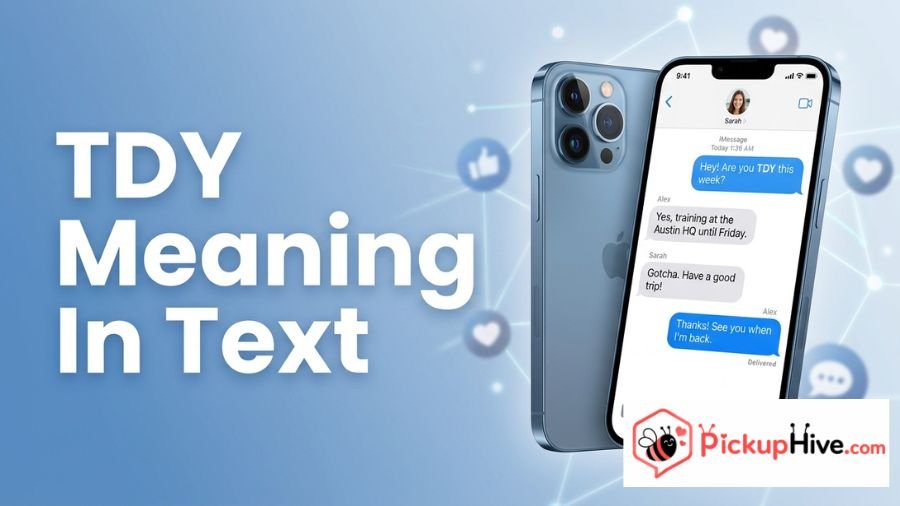
TDY Meaning In Text: Definition, Context, Examples, and Modern Usage (2026 Guide)
Imagine checking your phone and seeing, “Are you free TDY?” If you searched for TDY Meaning In Text, you’re probably wondering whether those three letters are slang, a typo, or a common abbreviation.
In casual texting, TDY usually means “today,” so the message simply asks whether you’re available today.
However, TDY can also mean “Temporary Duty” in military and professional contexts, which makes the abbreviation worth understanding before you assume its meaning.
As texting, social media, and quick digital conversations continue to favor shorter expressions, abbreviations like TDY can appear in messages, captions, comments, and DMs.
The good news is that the intended meaning is usually easy to identify once you look at the surrounding words.
In this guide, you’ll learn what TDY means, how people use it in different situations, and how to tell the difference between its casual and professional meanings.
Quick Answer / Quick Definition of “TDY Meaning In Text”
TDY usually means “today” in casual text messages, DMs, and social media conversations. It is an informal abbreviation used to make messages shorter and faster to type. However, in military or certain professional contexts, TDY can mean “Temporary Duty.” The surrounding conversation tells you which meaning is intended.
In a message such as “Are you busy TDY?”, the intended meaning is almost certainly “Are you busy today?”
Detailed Meaning Breakdown
Primary Meaning
The most common TDY Meaning In Text is “today.”
It is an informal abbreviation created by shortening the familiar word rather than changing its meaning. Someone might write:
“Are you working tdy?”
The full sentence would be:
“Are you working today?”
Nothing hidden is happening. The sender simply chose a shorter version.
You may see tdy, TDY, or occasionally mixed capitalization. In casual messages, capitalization usually doesn’t change the intended meaning. The surrounding words matter much more.
This kind of shortening is common in digital communication. People often use forms such as “tmr” for tomorrow, “rn” for right now, or “yday” for yesterday. TDY fits the same basic pattern.
One useful thing to remember is that TDY doesn’t normally add an emotion by itself. The sentence around it creates the feeling.
“Can’t meet tdy” sounds disappointing.
“Seeing you tdy!” sounds excited.
The abbreviation itself still means “today.”
Secondary Meanings
A second important meaning is “Temporary Duty.”
This use is especially associated with military and government-related communication. A person may say:
“I’ll be TDY next month.”
Here, TDY isn’t talking about the current day. It refers to a temporary assignment away from the person’s normal duty location.
That distinction matters because the same three letters can represent two completely different ideas.
In casual social conversation:
“Want to hang out TDY?”
usually means:
“Want to hang out today?”
In a military-related conversation:
“I’m going TDY next week.”
can mean:
“I’m going on temporary duty next week.”
The subject of the conversation provides the strongest clue.
Rare or Misinterpreted Meanings
Some abbreviations develop additional meanings in small communities, workplaces, hobbies, or online groups. That’s why you shouldn’t assume every three-letter abbreviation has one universal definition.
For everyday texting, “today” is the interpretation that normally makes the most grammatical sense when TDY appears beside words about plans, availability, appointments, school, work, or events.
A common mistake is treating every uppercase TDY as military terminology. Capitalization can provide a clue, but it isn’t proof.
Another mistake is assuming the abbreviation is automatically slang. Technically, it works more like an informal abbreviation or texting shorthand. It replaces a familiar word without necessarily creating a new meaning.
The safest approach is simple: read the whole message.
What “TDY Meaning In Text” Means in Different Contexts

In Texting and Messaging
In ordinary texting, TDY generally means today.
Friends may use it while making plans:
“Are you free TDY?”
That means:
“Are you free today?”
A family member might write:
“Can you pick me up tdy?”
The intended meaning is “Can you pick me up today?”
The abbreviation works because the conversation already gives you a time frame. There is little reason to write the longer word when the message is casual.
You might also see TDY in statements rather than questions:
“I have class tdy.”
“I’m staying home tdy.”
“Call me tdy when you’re free.”
In each case, replacing TDY with “today” creates a normal sentence.
I’ve found that the easiest way to decode short abbreviations is to mentally expand them. If the sentence suddenly sounds natural, you’ve probably found the intended meaning.
On Social Media Platforms
On Instagram, Snapchat, TikTok, and Threads, TDY can appear in captions, comments, stories, and DMs when someone means “today.”
For an Instagram Story, someone might post:
“Coffee date tdy.”
The message simply says that the coffee date is happening today.
On Snapchat, a friend might send:
“U free tdy?”
That is a quick request asking about today’s availability.
On TikTok, a creator could write:
“New video tdy!”
Here, the abbreviation tells followers that the video is being posted today.
On Threads, someone might casually write:
“Feeling productive tdy.”
The meaning remains the same.
There isn’t a special Instagram meaning or Snapchat meaning for TDY. The platform may change the tone of the conversation, but it generally doesn’t change what the abbreviation stands for.
In Dating and Relationships
In romantic conversations, TDY usually still means today. The relationship changes the emotional meaning of the complete sentence, not the definition of the abbreviation.
For example:
“Can I see you tdy?”
means:
“Can I see you today?”
A partner might say:
“Miss you. Wish I could see you tdy.”
The shortened word keeps the message informal and conversational.
Someone you’re dating might also ask:
“Are we still meeting tdy?”
That’s simply a confirmation about plans.
TDY isn’t inherently romantic, flirty, or suggestive. If a message feels affectionate, that feeling comes from the surrounding words.
This is worth remembering when interpreting a short message. Don’t read extra emotion into an abbreviation that doesn’t contain it.
In Professional Communication
Professional use requires more care because TDY can have a specialized meaning.
In a military or government context, TDY commonly refers to Temporary Duty. A sentence such as:
“She’ll be TDY for two weeks.”
may describe a temporary assignment away from her normal duty location.
In a regular workplace chat, however, someone could use “tdy” casually to mean “today”:
“Can you send the report tdy?”
That would mean “Can you send the report today?”
The problem is ambiguity.
If you’re dealing with formal documents, managers, clients, military personnel, or official communication, spelling out today is often clearer when that’s what you mean.
A tiny abbreviation isn’t worth creating a large misunderstanding.
Cultural or Regional Differences
The casual use of TDY for “today” can vary by person, age group, workplace, and online community. Some people use many texting abbreviations, while others almost always spell words out.
An older texter may prefer:
“Are you free today?”
A frequent texter may choose:
“Are you free tdy?”
Neither style changes the underlying meaning.
Regional differences can also affect familiarity. Someone who regularly communicates in English online may recognize TDY immediately, while another reader may need more context.
The specialized “Temporary Duty” meaning is particularly important in communities connected to military or government work.
So, when you see TDY, don’t rely only on the letters. Consider who sent it, what you’re discussing, and what the surrounding sentence says.
Tone, Psychology & Why People Use It
Why People Use It & What It Signals Socially
People generally use TDY because it is short, convenient, and easy to understand in casual conversation.
Typing:
“Are you coming today?”
takes slightly longer than:
“Are you coming tdy?”
The difference is tiny, but digital communication is full of tiny shortcuts.
Using an abbreviation can also signal informality. A person who normally texts with shortened words may use TDY without thinking about it.
It can make a message feel quick and conversational rather than carefully written.
For example:
“Can we talk tdy?”
feels like a normal quick text.
“Can we talk today?”
is equally natural but slightly more complete.
Neither one automatically says anything about how the sender feels.
Emotional Layer Behind It
The emotional tone comes from the sentence around TDY.
A friendly message might say:
“Finally seeing you tdy!”
A neutral message could be:
“I’m working tdy.”
A frustrated message might say:
“Everything went wrong tdy.”
The abbreviation is identical in all three messages.
That’s why TDY Meaning In Text should not be interpreted as a mood or personality signal by itself.
If someone sends only:
“tdy?”
you may need more context. They could be asking whether something is happening today, checking your availability, or referring to an earlier plan.
When the meaning isn’t obvious, asking for clarification is better than guessing.
10 Real Conversation Examples (Explained)
1. “Are you free tdy?”
Intended meaning: Are you free today?
Tone: Casual and friendly.
Likely interpretation: The sender wants to know your availability for the current day.
2. “I have a dentist appointment tdy.”
Intended meaning: The appointment is today.
Tone: Neutral and informational.
Likely interpretation: The sender is giving you a schedule update, not asking a question.
3. “Can we meet tdy?”
Intended meaning: Can we meet today?
Tone: Direct but casual.
Likely interpretation: The sender is trying to arrange a same-day meeting.
4. “Busy tdy, sorry.”
Intended meaning: I’m busy today.
Tone: Apologetic and slightly constrained.
Likely interpretation: The person probably can’t participate in the plan because of today’s schedule.
5. “Best day ever tdy!”
Intended meaning: Today has been an especially good day.
Tone: Excited and positive.
Likely interpretation: The abbreviation is part of an enthusiastic update.
6. “Call me tdy when you get home.”
Intended meaning: Call me today after you get home.
Tone: Familiar and practical.
Likely interpretation: The sender wants a phone call sometime later during the current day.
7. “Are we still going out tdy?”
Intended meaning: Are our plans for today still happening?
Tone: Casual and slightly uncertain.
Likely interpretation: The sender wants confirmation rather than making a new invitation.
8. “I’m TDY next month.”
Intended meaning: In a military or specialized professional context, this may mean Temporary Duty.
Tone: Professional and informational.
Likely interpretation: The person is referring to a temporary work assignment, not “today.”
9. “Posting the photos tdy.”
Intended meaning: The photos are being posted today.
Tone: Casual and social.
Likely interpretation: The sender is giving followers or friends a timing update.
10. “Can’t talk tdy. I’ll message tomorrow.”
Intended meaning: The person cannot communicate today.
Tone: Neutral and boundary-setting.
Likely interpretation: The sender is unavailable for the rest of the day and expects communication tomorrow.
These examples show why the sentence matters more than the abbreviation alone. TDY stays short, but its surrounding context tells you exactly how to read it.
Where Misunderstandings Happen
Context Confusion
The biggest problem happens when the reader knows only the abbreviation and not the topic.
If someone says:
“I’m TDY next week,”
a casual texter might initially think the letters mean “today.” But “next week” makes that interpretation impossible.
The phrase “temporary duty” fits the professional context much better.
Likewise, if someone says:
“Want to grab lunch tdy?”
the word “today” clearly fits.
Look at the surrounding time expressions. Words such as “today,” “tomorrow,” “next week,” “assignment,” “base,” “travel,” or “work trip” can quickly reveal the intended meaning.
Generational Gap
Not everyone uses texting shortcuts at the same rate.
One person may consider TDY obvious. Another may see it as an unexplained abbreviation.
This can create unnecessary confusion between family members, coworkers, teachers, students, or people meeting online for the first time.
If you’re writing to someone whose texting style you don’t know, using today instead of TDY is the safer option.
There is no benefit in making a simple sentence harder to understand.
Platform Differences
The platform itself doesn’t normally create a new meaning for TDY, but it can affect how often abbreviations appear.
A quick Snapchat message may contain several shortened words.
An Instagram caption may use TDY as part of a short update.
A professional workplace platform may make the military meaning more likely if the discussion involves duty assignments.
The key is not the app alone. It’s the combination of platform, audience, topic, and sentence structure.
Similar Words, Symbols, or Abbreviations
| Term | Meaning | How It Differs from TDY |
|---|---|---|
| Today | The current day | The standard full word; TDY is a shortened form in casual texting |
| Tmr | Tomorrow | Refers to the next day rather than the current day |
| Tmrw | Tomorrow | Another informal spelling for the following day |
| Rn | Right now | Refers to the current moment, not the entire day |
| Yday | Yesterday | Refers to the previous day |
| 2day | Today | Another informal way to represent “today” |
| ASAP | As soon as possible | Describes urgency rather than a specific day |
| ETA | Estimated time of arrival | Refers to an expected arrival time |
| Temp | Temporary | Can describe something temporary but doesn’t specifically mean “today” |
| TDY | Temporary Duty | A specialized meaning that differs completely from casual “today” usage |
The most important comparison is between TDY and today. When TDY is being used as texting shorthand, they communicate the same basic time reference.
The major exception is professional or military context, where TDY can represent Temporary Duty instead.
Also Read This: What Does SMH Mean
When Not to Use “TDY Meaning In Text”
Professional Risks
Avoid using TDY for “today” in formal emails, official reports, applications, contracts, school assignments, or important business communication.
Instead of:
“Please send the document tdy.”
write:
“Please send the document today.”
The full word is clearer and removes unnecessary ambiguity.
This is especially useful when your audience may interpret TDY as Temporary Duty.
Cultural Risks
Not every reader is familiar with internet shorthand.
If you’re communicating with someone who speaks English as a second language, a customer, an older relative, or someone outside your usual online community, the full word may be easier.
Abbreviations are helpful only when the reader understands them.
Tone Risks
TDY isn’t normally rude, but using abbreviations in serious conversations can sometimes make a message feel rushed.
Compare:
“I’m sorry I can’t be there tdy.”
with:
“I’m sorry I can’t be there today.”
The second version may feel more deliberate and personal, especially when the situation is emotional.
This doesn’t mean TDY is inappropriate in every serious conversation. It simply means that spelling out the word can better match the tone you want.
Expert Tips for Using “TDY Meaning In Text” Correctly
- Use TDY mainly in casual conversations where the other person understands texting shortcuts.
- Read the whole sentence first before deciding what TDY means.
- Look for time clues such as tomorrow, next week, later, or yesterday.
- Watch the subject matter. Military or government discussions may use TDY to mean Temporary Duty.
- Don’t assume capitalization gives the answer. Context is more reliable than uppercase or lowercase letters.
- Use “today” in formal writing when you mean the current day.
- Match the other person’s texting style instead of filling every message with abbreviations.
- Ask for clarification if TDY could reasonably have more than one meaning.
- Don’t treat TDY as inherently flirty, rude, positive, or negative. The surrounding message creates the tone.
- Prefer clarity over speed when the message involves schedules, deadlines, travel, work assignments, or important plans.
Frequently Asked Questions
1. What does TDY mean in text?
In most casual texting situations, TDY means “today.” It is an informal abbreviation used to shorten the word and make messages quicker to type. For example, “Are you free tdy?” means “Are you free today?” However, the abbreviation can mean Temporary Duty in military or specialized professional communication.
2. Is TDY slang or an abbreviation?
TDY is better described as an informal texting abbreviation when it means “today.” It doesn’t create a completely new word or idea. Instead, it shortens a familiar word for convenience. People may casually call it slang, but “texting shorthand” is a more precise description of how it functions in everyday messages.
3. Is TDY positive or negative?
TDY itself is neutral. It doesn’t express happiness, anger, sadness, affection, or annoyance. The emotional meaning comes from the rest of the sentence. “Can’t see you tdy” may sound disappointing, while “Finally seeing you tdy!” sounds excited. The abbreviation simply identifies the current day.
4. Can TDY have a romantic meaning?
Yes, but only because of the surrounding message. TDY itself isn’t romantic. Someone you’re dating might write, “Can I see you tdy?” meaning “Can I see you today?” The romantic feeling comes from the relationship and the invitation, not from the letters TDY.
5. What does TDY mean on Snapchat?
On Snapchat, TDY can simply mean “today” when used in casual conversation. For example, “What are you doing tdy?” asks about the person’s plans for today. Snapchat doesn’t give TDY a special platform-specific definition. As always, the surrounding words and topic should guide your interpretation.
6. Does TDY mean something different in the military?
Yes. In military communication, TDY commonly means “Temporary Duty.” It can refer to a temporary assignment away from a person’s normal duty location. This is very different from the casual texting use of TDY meaning “today,” so professional context matters greatly.
7. How should I reply when someone texts “Are you free tdy?”
Reply according to your availability. You could say, “Yeah, I’m free after 6,” “No, I’m busy today,” or “What did you have in mind?” You don’t need to repeat the abbreviation. A normal conversational response is perfectly fine.
8. Should I use TDY in a formal email?
Usually, no, if you mean “today.” In formal emails, reports, applications, and official communication, writing today is clearer and more professional. It also prevents confusion with the established professional meaning of TDY, especially in military or government-related settings.
9. Why do people write TDY instead of today?
The main reason is speed and convenience. Texting often favors short forms, especially when people are sending quick messages from their phones. Some users also develop personal habits around abbreviations. TDY lets them shorten a common word without changing the basic meaning.
10. Does TDY mean “today” on Instagram and TikTok?
It can. In casual Instagram DMs, TikTok comments, captions, or other social posts, TDY may be used as a shortened form of “today.” For example, “New video tdy” means “New video today.” The platform doesn’t fundamentally change the abbreviation’s meaning.
11. How can I tell whether TDY means “today” or “Temporary Duty”?
Look at the topic. If the message discusses plans, lunch, school, appointments, or what someone is doing, “today” is usually the natural interpretation. If it discusses military assignments, official travel, duty stations, or temporary work placement, “Temporary Duty” may be intended.
12. Is TDY the same as “2day”?
When both are used as casual texting abbreviations, they can refer to the same word: today. The difference is simply the spelling style. “2day” uses the number 2 to represent the “to” sound, while TDY is a shortened letter-based form.
Final Summary & Smart Usage Advice
The simplest TDY Meaning In Text is “today.” In casual messages, people use TDY as a quick abbreviation when talking about plans, schedules, events, appointments, or anything happening during the current day.
For example, “Are you free tdy?” simply means “Are you free today?” The abbreviation doesn’t automatically make the message romantic, rude, friendly, or negative. Those feelings come from the surrounding words and the relationship between the people communicating.
There is one major exception worth remembering. In military and certain professional settings, TDY can mean “Temporary Duty.” That meaning is completely different, so context matters. If someone says they are “going TDY next week” while discussing work assignments or military travel, don’t automatically replace TDY with “today.”
For everyday social communication, TDY can work well when the audience is familiar with texting shorthand. For formal emails, important instructions, professional documents, and situations where confusion could cause problems, writing today is the clearer choice.
The easiest rule is this:
If the conversation is about the current day, TDY usually means “today”; if it’s about a military or specialized work assignment, check for the “Temporary Duty” meaning.

Hi, I’m Jackson Hayes, a digital content writer at PickupHive.com passionate about creating clever pickup lines and entertaining conversation starters.

[…] TDY Meaning In Text […]