























XO Meaning in Text? Meaning, Context, Examples, and Modern Usage (2026 Guide)
Imagine you’re texting a friend goodnight, and they end their message with “XO.” You might wonder whether they’re saying goodbye, sending a kiss, or expressing something romantic. If you’ve searched for XO Meaning in Text, you’re probably trying to figure out what those two letters mean and what someone wants to communicate by using them.
The good news is that XO is one of the simplest expressions to understand once you know the meaning behind it. People commonly use it in text messages, social media comments, captions, and private conversations to express hugs and kisses. However, the exact feeling behind it can change depending on who sends it and what the conversation is about.
For example, XO from a close friend may feel warm and friendly, while the same letters from someone you’re dating might carry a romantic message. Sometimes, people even use it as a casual sign-off without expecting a serious response.
In this guide, you’ll learn what XO means, how people use it on different platforms, what it communicates emotionally, and how to respond naturally. You’ll also discover real conversation examples, common misunderstandings, and useful tips for understanding XO in everyday digital communication.
Quick Answer: What Does XO Mean?
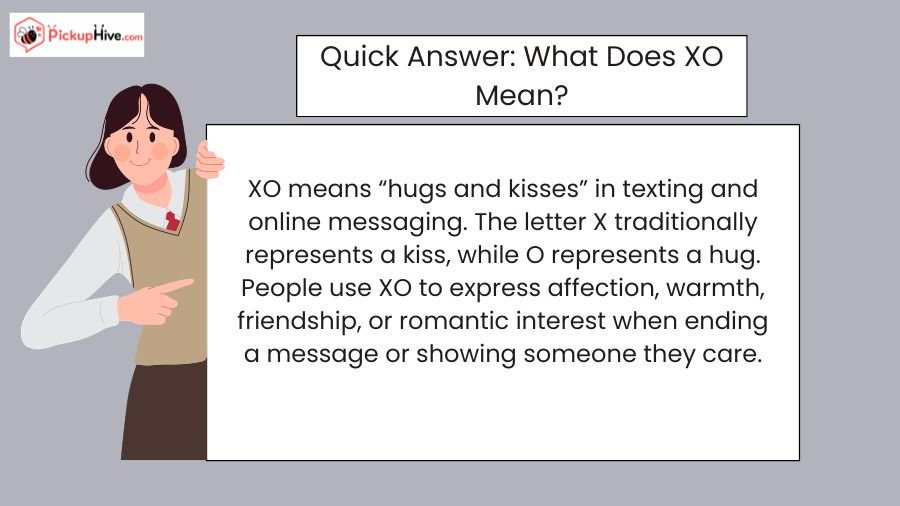
XO means “hugs and kisses” in texting and online messaging. The letter X traditionally represents a kiss, while O represents a hug. People use XO to express affection, warmth, friendship, or romantic interest when ending a message or showing someone they care.
A: Goodnight! Talk to you tomorrow.
B: Goodnight, XO!
A: Thanks for always being there for me.
B: Of course! XO
Detailed Meaning Breakdown
Primary Meaning
The most common meaning of XO is hugs and kisses. It’s a short, affectionate expression that people use to communicate warmth without writing a long emotional message.
The two letters have different symbolic meanings:
-
X = Kiss: The letter X represents a kiss or an affectionate gesture.
-
O = Hug: The letter O represents a hug, suggesting closeness and comfort.
Together, they create a friendly way to send affection through a screen. Someone might add XO to a goodnight message, a birthday wish, or a conversation with a loved one.
For example:
“Hope you have an amazing day! XO”
This message communicates kindness and affection. It doesn’t necessarily mean the sender is romantically interested in the recipient.
One interesting thing about XO is how much meaning two letters can carry. A short sign-off can make an ordinary message feel warmer and more personal.
Secondary Meanings
Although hugs and kisses are the standard interpretation, XO can have slightly different meanings depending on the situation.
1. Love and affection
People often use XO when communicating with partners, family members, or close friends.
Example: “Missing you already, XO.”
Here, the expression reinforces the sender’s affection.
2. A friendly goodbye
XO can function as a casual sign-off at the end of a conversation.
Example: “Okay, I’ll call you later. XO!”
The sender is simply ending the conversation on a warm note.
3. Emotional support
Someone may use XO when comforting another person.
Example: “I’m sorry you’re going through this. Sending you XO.”
In this case, the letters communicate sympathy and emotional support.
4. Playful affection
Friends sometimes use XO jokingly or playfully, particularly after sharing a funny story or teasing each other.
Example: “You’re ridiculous, but I love you. XO.”
The overall conversation helps determine whether the expression feels sweet, humorous, or romantic.
Rare or Misinterpreted Meanings
XO doesn’t always refer to hugs and kisses in every situation. Some people use the letters in names, product labels, entertainment, or other specialized contexts.
For example, XO can refer to an executive officer in military or organizational settings. It can also appear in brand names, song titles, and references to the XO game, commonly called tic-tac-toe.
However, these meanings are less likely when someone sends XO at the end of an ordinary personal message.
Another common misunderstanding is assuming that XO automatically means romantic love. It doesn’t. A person can send XO to a sibling, a parent, a best friend, or a romantic partner.
The surrounding conversation matters more than the letters alone. If someone regularly uses affectionate language with everyone, XO may simply be part of their normal communication style.
What XO Means in Different Contexts
In Texting and Messaging
In everyday texting, XO usually adds a little warmth to a message. People often place it at the end of a sentence, especially when saying goodbye, expressing gratitude, or wishing someone well.
For example:
“Made it home safely. Thanks for checking on me, XO.”
The sender is showing appreciation and affection rather than introducing a new topic.
You might also see XO in messages such as:
-
“Sleep well tonight, XO.”
-
“Good luck with your interview tomorrow! XO”
-
“Happy birthday! Hope your day is wonderful, XO.”
Notice how the expression doesn’t change the main message. Instead, it adds a personal touch.
People who communicate mostly through short texts may use XO because it expresses a feeling without requiring a lengthy explanation.
However, not everyone uses affectionate abbreviations. If someone normally writes direct, simple messages, they may prefer saying “take care” or “talk soon” instead.
On Social Media Platforms
XO appears across social media, but the way people use it can vary with the type of content and audience.
Instagram: People often add XO to captions, comments, and direct messages. A person might end a birthday post for a friend with “Love you always, XO.”
Snapchat: XO can appear in quick messages, selfies, or conversations with close friends. It may make a short message feel more affectionate.
TikTok: Users sometimes include XO in video captions or comments, particularly when discussing relationships, friendships, or emotional moments. Its meaning still depends on the content.
Threads: XO may appear in personal updates or friendly replies. It can make a short written response sound warmer or more intimate.
A small detail worth remembering is that a public comment and a private message don’t always communicate the same level of closeness. Someone may use XO publicly as a general expression of affection, while a private message may carry a more personal meaning.
In Dating and Relationships
In romantic conversations, XO can be a sign of affection, attraction, or emotional closeness. Someone might use it after a sweet conversation, before going to sleep, or when wishing their partner a good day.
For example:
“Can’t wait to see you this weekend. XO.”
This message sounds affectionate and may suggest romantic interest when it comes from someone you’re dating.
Another example is:
“You made my day today, XO.”
Here, the sender is adding warmth to an expression of appreciation.
However, XO alone isn’t proof that someone has romantic feelings. Some people naturally communicate affectionately, even with people they aren’t dating.
If you’re trying to understand a potential romantic interest, consider the broader pattern. Do they initiate conversations, show interest in your life, and make an effort to spend time with you? Those behaviors provide more useful context than two letters.
In Professional Communication
XO is generally too informal for most professional messages, especially when communicating with clients, managers, recruiters, or people you don’t know well.
For example, ending a job application email with “Best regards, XO” could seem overly personal or inappropriate.
In a friendly workplace where colleagues know each other well, an occasional affectionate sign-off might be acceptable. Still, it’s safer to use conventional closings in professional settings.
Better alternatives include:
-
Best regards
-
Thanks again
-
Take care
-
All the best
Professional communication usually benefits from clarity and appropriate boundaries. Unless you know that affectionate expressions are welcome, keep XO for personal conversations.
Cultural or Regional Differences
XO is widely recognizable in English-language digital communication, particularly in casual messages and social media. However, its frequency and emotional weight vary between people and communities.
Some families regularly end messages with hugs and kisses, while others rarely use these expressions. In certain friend groups, XO may feel completely ordinary. In others, it might seem unusually intimate.
Age and personal communication habits can also influence how people interpret it. Someone who frequently uses text abbreviations may see XO as a simple sign-off, while another person might interpret it as a stronger expression of affection.
There isn’t one universal rule about how much affection XO communicates.
The safest interpretation comes from the relationship, the conversation, and the sender’s usual style, rather than assuming everyone attaches the same meaning to it.
Where Is XO Used?
-
Snapchat 👻: Friends may send “XO” after a late-night conversation to express affection before leaving the chat.
-
TikTok 🎵: A creator might add XO to a heartfelt caption thanking followers for their support.
-
Instagram DMs 📩: Someone may end a private message with XO after wishing a friend good luck.
-
WhatsApp 💬: Family members may use XO when saying goodnight or checking in on someone they love.
-
Gaming chats 🎮: Friends who know each other well might add XO to a playful message after finishing a game together.
XO is primarily casual and informal. It can work in friendly personal conversations and some semi-formal situations where people already share a close relationship. In formal emails, business proposals, and professional introductions, a standard sign-off is usually more appropriate.
Tone, Psychology & Why People Use It
Why People Use XO and What It Signals Socially
People often communicate emotions through small details in digital messages. Since text doesn’t naturally include facial expressions, physical gestures, or vocal tone, abbreviations and symbols can help communicate feelings.
XO offers a simple way to express affection without writing an entire sentence about it.
For example, compare these messages:
“Thanks for helping me.”
“Thanks for helping me. XO”
Both express gratitude, but the second adds a warmer, more personal feeling.
People may also use XO to maintain a sense of closeness when they live far apart. A parent texting a child at college, for instance, might use it to communicate affection despite the distance.
In friendships, it can reinforce familiarity. Between romantic partners, it may become part of their shared communication style.
There’s no need to attach a deep psychological meaning to every use, though. Sometimes people use XO simply because it’s a familiar habit.
Emotional Layer Behind XO
The emotional tone of XO can range from friendly to romantic, depending on the message.
Warm and affectionate: “Hope your appointment goes well tomorrow, XO.”
The sender is showing care and support.
Romantic: “Wish you were here with me tonight. XO.”
In a relationship, this may express longing and intimacy.
Playful: “You owe me coffee after that disaster. XO.”
The sender combines teasing with friendliness.
Comforting: “Take all the time you need. I’m here for you, XO.”
The expression adds tenderness to a supportive message.
Casual: “Okay, talk later! XO.”
Here, it may function as a routine goodbye.
The letters themselves don’t tell you exactly what someone feels. Their word choice, relationship history, and usual texting style provide the missing clues.
10 Real Conversation Examples Explained
These examples show how XO can communicate different feelings in everyday situations.
Example 1: Saying Goodnight
Message: “I’m heading to bed now. Sleep well, XO.”
Intended meaning: The sender is wishing the other person a peaceful night while expressing affection.
Emotional tone: Warm and caring.
Likely interpretation: A friendly or affectionate goodbye, especially between people who regularly keep in touch.
Example 2: Romantic Interest
Message: “Today was even better because I got to see you. XO.”
Intended meaning: The sender enjoyed spending time with the recipient and wants to express that feeling.
Emotional tone: Sweet and potentially romantic.
Likely interpretation: It may suggest attraction if the sender has also shown other signs of romantic interest.
Example 3: Supporting a Friend
Message: “I know things have been rough lately. You’ve got this, XO.”
Intended meaning: The sender wants to encourage a friend during a difficult period.
Emotional tone: Supportive and reassuring.
Likely interpretation: The letters add affection to a message focused on emotional support.
Example 4: Birthday Wishes
Message: “Happy birthday! Hope this year brings you everything you want, XO.”
Intended meaning: The sender is celebrating the recipient and wishing them well.
Emotional tone: Cheerful and affectionate.
Likely interpretation: A personal birthday greeting, not necessarily a romantic signal.
Example 5: Family Conversation
Message: “Don’t forget your jacket. It’s cold outside. XO.”
Intended meaning: The sender is showing concern for the recipient’s comfort and safety.
Emotional tone: Caring and familiar.
Likely interpretation: The expression adds warmth to an everyday reminder, as might happen between relatives.
Example 6: Thanking Someone
Message: “You really helped me out today. I appreciate you, XO.”
Intended meaning: The sender wants to communicate gratitude along with affection.
Emotional tone: Appreciative and sincere.
Likely interpretation: The sender values the recipient’s help and wants the message to feel personal.
Example 7: Playful Friendship
Message: “You’re still the worst person to share snacks with. XO.”
Intended meaning: The sender is teasing a friend while keeping the message affectionate.
Emotional tone: Humorous and friendly.
Likely interpretation: The teasing is probably lighthearted if the friendship already includes playful banter.
Example 8: Long-Distance Relationship
Message: “Counting down the days until we’re together again. XO.”
Intended meaning: The sender misses the recipient and looks forward to seeing them.
Emotional tone: Romantic and longing.
Likely interpretation: In an established relationship, the message communicates closeness despite the distance.
Example 9: Ending a Casual Conversation
Message: “All right, I’ll message you after work. XO.”
Intended meaning: The sender is wrapping up the conversation on a friendly note.
Emotional tone: Relaxed and familiar.
Likely interpretation: It may simply be the sender’s usual sign-off, with no hidden message.
Example 10: Reconnecting With an Old Friend
Message: “It’s been forever! We need to catch up soon, XO.”
Intended meaning: The sender is expressing warmth and interest in reconnecting.
Emotional tone: Nostalgic and friendly.
Likely interpretation: The sender wants to renew the connection, although the sincerity of future plans depends on what happens next.
Also Read This: DN Meaning in Text
Where Misunderstandings Happen
Context Confusion
One of the most common misunderstandings happens when someone assumes XO always represents romantic interest.
Imagine receiving XO from a friend you’ve known for years. It might simply reflect your established friendship. If you receive the same expression from someone you’ve recently started dating, it may feel more intimate.
The letters are identical, but the relationships are different.
To avoid confusion, read the entire message instead of focusing on the sign-off. Look at the topic, the sender’s tone, and how they normally communicate.
Generational Gap
People develop different texting habits depending on their age, social circles, and personal preferences.
Someone who grew up exchanging affectionate messages may use XO automatically. Another person might rarely see it and wonder whether it signals a kiss, a hug, or a romantic invitation.
Neither interpretation is necessarily wrong. They simply reflect different communication habits.
If you’re unsure what a person means, a little context is usually enough to clarify things without making the situation awkward.
Platform Differences
The same expression can feel different in a public comment and a private message.
For example, XO under a friend’s birthday picture may be a casual public display of affection. In a private message after an emotional conversation, it may feel more personal.
Platform culture also affects how people write. A short caption may use XO for style, while a direct message may use it to communicate genuine affection.
Avoid interpreting the expression in isolation. The message and the relationship matter more than the platform itself.
Similar Words, Symbols, or Abbreviations
Several expressions can communicate affection or warmth, but each has its own typical use.
| Term | Meaning | How It Differs from XO |
|---|---|---|
| XOXO | Hugs and kisses | Repeats the symbols and often feels more emphatic or playful. |
| X | Kiss or affectionate sign-off | Usually focuses on a kiss rather than both hugs and kisses. |
| ❤️ | Red heart emoji | Expresses love or affection visually without using letters. |
| 😘 | Face blowing a kiss | Communicates a kiss more directly and can feel flirtatious. |
| 🫂 | People hugging emoji | Emphasizes a hug, comfort, or emotional support. |
| Love ya | Casual expression of love | Uses words instead of symbols and can sound more direct. |
| Mwah | Written kissing sound | Imitates the sound of a kiss and often feels playful. |
| LOL | Laughing out loud | Signals amusement rather than affection. |
| GN | Good night | Indicates a nighttime sign-off without necessarily expressing affection. |
| BRB | Be right back | Communicates a temporary departure rather than an affectionate goodbye. |
Although some of these expressions overlap, they aren’t interchangeable in every conversation. A heart emoji, for example, may communicate affection without specifically suggesting hugs and kisses.
When Not to Use XO
Professional Risks
XO can seem overly familiar in professional settings. A client, recruiter, or new colleague might find it confusing if you use affectionate sign-offs before establishing a personal relationship.
For example, “Your proposal is attached. XO” may undermine the professional tone of an otherwise clear email.
Use conventional greetings and closings for business communication unless you already know the recipient welcomes a more personal style.
Cultural Risks
Not everyone is comfortable expressing affection through text. Some people reserve hugs and kisses for close family members or romantic partners, while others use them freely among friends.
If you don’t know someone’s preferences, avoid assuming they welcome affectionate symbols. A friendly “Take care” is often a safer option.
Respecting another person’s communication style helps prevent a small expression from becoming an uncomfortable moment.
Tone Risks
XO may seem inappropriate when the conversation involves conflict, serious boundaries, or a sensitive topic.
For instance, adding XO after a dismissive message could make the sender seem sarcastic rather than caring.
Consider the emotional weight of the conversation before using affectionate sign-offs. When someone is upset, a thoughtful and direct response may communicate more empathy than a symbol.
Expert Tips for Using XO Correctly
-
Consider your relationship. XO is usually most natural with close friends, relatives, and romantic partners.
-
Read the conversation first. Match the expression to the mood instead of adding it automatically.
-
Don’t assume romance. Receiving XO doesn’t prove that someone has a crush on you.
-
Keep it simple. One XO is usually enough to communicate warmth.
-
Notice the sender’s habits. If they use it with everyone, it may not carry a special meaning.
-
Choose the right setting. Save affectionate sign-offs for personal messages rather than formal business emails.
-
Respond naturally. You can reply with XO, a heart emoji, or a simple friendly message.
-
Respect personal boundaries. If someone prefers less affectionate communication, follow their lead.
-
Look at the bigger picture. Consistent behavior tells you more about someone’s feelings than a single abbreviation.
-
Avoid overthinking it. Sometimes XO is just a sweet way to end a conversation.
Frequently Asked Questions
1. What does XO mean in a text message?
XO usually means hugs and kisses. The X symbolizes a kiss, while the O represents a hug. People add it to messages to show affection, friendliness, or love. Its exact meaning depends on the sender, the recipient, and the conversation. In many cases, it’s simply a warm way to say goodbye.
2. Does XO mean love?
XO can express love, but it doesn’t always mean romantic love. Parents, siblings, friends, and partners may all use it to show affection. If someone sends you XO, consider your relationship and their usual communication style before drawing conclusions. The expression indicates warmth, but it doesn’t automatically define the relationship.
3. Is XO flirty or romantic?
XO can sound flirty or romantic when it appears in a conversation between people who are dating or exploring mutual attraction. However, friends also use it without any romantic intention. Look at other clues, such as compliments, invitations, and the overall tone of the conversation, rather than relying on the abbreviation alone.
4. What does XOXO mean, and how is it different from XO?
XOXO also means hugs and kisses. It repeats the X and O symbols, often creating a more expressive, playful, or emphatic sign-off. The difference is usually stylistic rather than a completely different meaning. Both expressions can be affectionate, and neither one automatically indicates romantic interest.
5. What should I reply when someone texts XO?
Your response can match the relationship and the tone of the conversation. If it’s a close friend, you could reply “XO!” or send a heart emoji. If it’s a romantic partner, a warm message may feel natural. If you’re unsure what the sender intends, a simple “Talk soon!” is perfectly fine.
6. Does XO mean hugs and kisses on Snapchat?
Yes, XO commonly means hugs and kisses on Snapchat, just as it does in ordinary texting. Someone might send it after a friendly conversation or add it to a message before going offline. The platform doesn’t change the basic meaning, although the sender’s relationship with you can influence how affectionate the message feels.
7. Can I use XO with friends and family?
Absolutely. XO is commonly used with close friends and family members to express care, appreciation, or affection. For example, you might add it to a birthday wish for your sister or a goodnight message to a friend. You don’t need to be romantically involved with someone to use the expression.
8. Is XO appropriate for work emails or formal messages?
Generally, no. XO is an informal expression of affection and may seem too personal in a business email, job application, or message to an unfamiliar colleague. Use closings such as “Best regards,” “Thank you,” or “All the best” instead. In a close personal friendship outside formal work communication, XO may be perfectly acceptable.
Final Summary & Smart Usage Advice
Understanding XO is easy once you know what the letters represent. In everyday texting, XO means hugs and kisses, with X symbolizing a kiss and O representing a hug. People use it to express affection, friendliness, warmth, and sometimes romantic interest.
You’ll commonly see it in goodnight messages, birthday wishes, private conversations, social media captions, and messages between close friends or family members. In romantic relationships, it can make a message feel sweeter or more intimate. In friendships, it may simply be a familiar way to show someone you care.
The most important thing to remember is that XO doesn’t carry exactly the same emotional meaning in every situation. A friend may use it casually, while a romantic partner may use it to express closeness. Someone else might include it automatically at the end of nearly every personal message.
If you receive XO, you don’t need to overthink your response. Reply with a similar expression if it feels natural, or continue the conversation normally. If you’re deciding whether to use it yourself, consider the recipient, the situation, and your usual communication style.
It’s also best to avoid XO in formal professional messages, where a conventional sign-off is more appropriate.
Now you know how to recognize the expression, interpret its tone, and use it comfortably in everyday conversations.
Remember: XO usually means hugs and kisses, but the relationship and context reveal how much affection the sender intends to express.

Hi, I’m Jackson Hayes, a digital content writer at PickupHive.com passionate about creating clever pickup lines and entertaining conversation starters.
[…] XO Meaning in Text […]
[…] XO Meaning in Text […]