























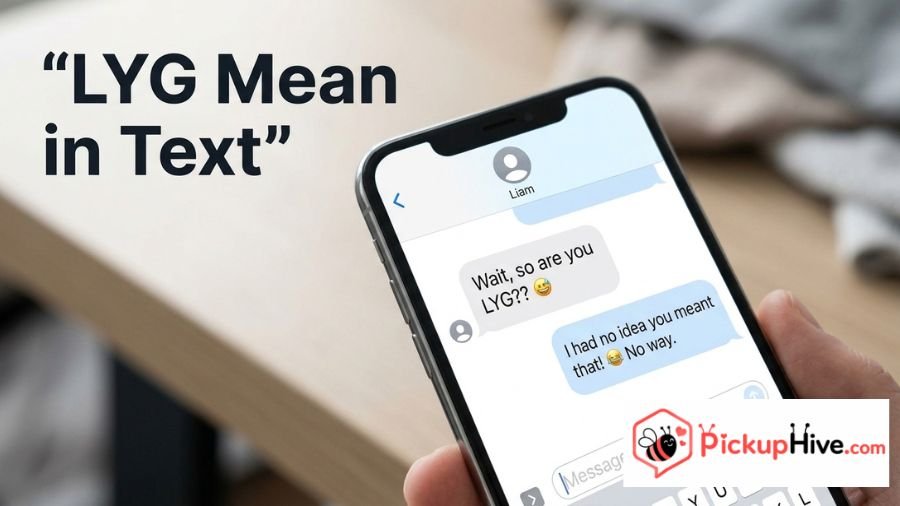
What Does LYG Mean in Text? Meaning, Context, Examples, and Modern Usage (2026 Guide)
Imagine you’re texting a friend and they suddenly reply, “lyg 😭”. If you’ve been searching LYG Mean in Text, you’re probably wondering whether those three letters mean disbelief, sarcasm, or something else entirely.
You understand the conversation, but the abbreviation makes you stop for a second. Is it a joke? Are they calling you a liar? Or are they simply reacting to something surprising?
That confusion is common because LYG isn’t one of the most universally understood texting abbreviations. Its meaning can depend on the sentence, the relationship between the people, and the tone of the conversation.
In casual online conversations, LYG can express disbelief, skepticism, sarcasm, or playful doubt. Sometimes it feels similar to saying, “Seriously?” or “Yeah, right.” However, it doesn’t always mean that someone is directly accusing another person of lying.
I’ve noticed that short slang can create more confusion than longer messages. Three letters can carry a surprising amount of emotion.
In this guide, we’ll break down LYG in simple English, with real examples, social media contexts, relationship situations, and tips for using it correctly.
Quick Answer: What Does LYG Mean?
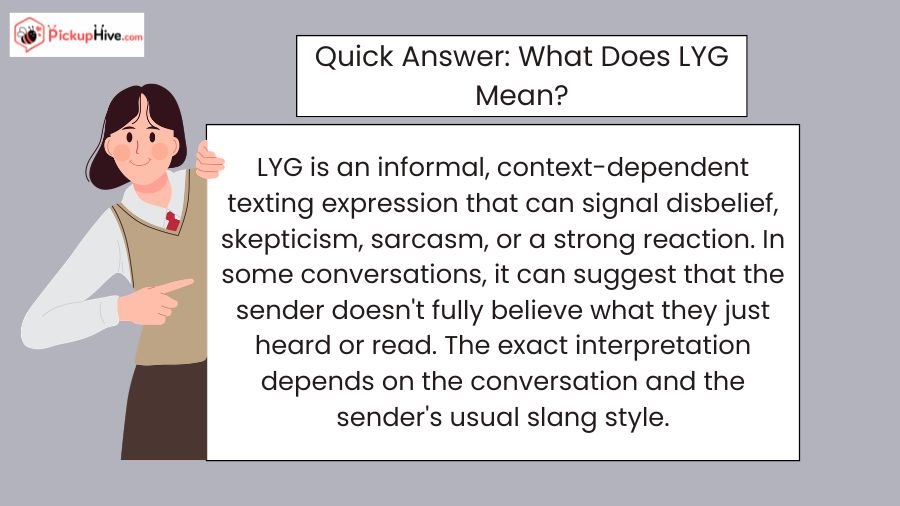
LYG is an informal, context-dependent texting expression that can signal disbelief, skepticism, sarcasm, or a strong reaction. In some conversations, it can suggest that the sender doesn’t fully believe what they just heard or read. The exact interpretation depends on the conversation and the sender’s usual slang style.
A: “You finished the whole project in 20 minutes?”
B: “lyg 😭”
A: “He said he forgot again.”
B: “lyg.”
Detailed Meaning Breakdown
Primary Meaning
The most useful way to understand LYG is as a casual reaction to something surprising or difficult to believe.
A person may use it when a statement sounds exaggerated, unexpected, suspicious, or almost too funny to accept.
For example:
“She said she got front-row tickets for free.”
A friend might answer:
“lyg 😭”
Here, the response doesn’t necessarily mean, “You are definitely lying.” It may simply communicate, “Wait, seriously?”
That’s an important distinction.
Texting slang often communicates emotion rather than a precise dictionary definition. LYG can act more like a reaction marker than a complete sentence.
Secondary Meanings
Depending on the conversation, LYG may suggest:
- Disbelief
- Playful skepticism
- Sarcasm
- Surprise
- Mild teasing
- Doubt
- An amused reaction
The emotional strength can change too.
A simple “lyg” may sound doubtful. Adding an emoji can make it playful:
“lyg 😂”
Adding punctuation may make it sharper:
“lyg??”
The surrounding words matter more than capitalization.
Rare or Misinterpreted Meanings
One common mistake is assuming LYG always means “you’re lying.”
That interpretation can be too strong.
If someone says:
“I just met my favorite singer at the airport.”
and their friend responds:
“lyg 😭”
the friend may be expressing shock rather than making a serious accusation.
Another issue is confusing LYG with similar-looking abbreviations. Short slang terms can be mistyped, customized, or used differently by different communities.
If the meaning isn’t obvious, look at the complete sentence instead of trying to decode the letters alone.
What LYG Means in Different Contexts
In Texting and Messaging
In ordinary texting, LYG is most useful as a quick emotional reaction.
Friends might use it when someone shares gossip, an unbelievable story, an unexpected achievement, or an exaggerated claim.
For example:
“Bro said he studied all night and still got 100.”
“lyg 😭”
The message communicates doubt with a humorous edge.
Another person might write:
“She told me she’s never watched that show.”
“lyg.”
The second example feels more skeptical because there is no laughing emoji.
A small observation from everyday texting is that punctuation can change the emotional temperature. “lyg 😂” feels much softer than “LYG.” The letters stay the same, but the social signal changes.
On Social Media Platforms
On Instagram, Snapchat, TikTok, and Threads, LYG can appear in comments, DMs, captions, replies, or private conversations.
On Instagram, it may appear under a friend’s post when the caption sounds exaggerated.
On Snapchat, it can be a quick response to a surprising story.
On TikTok, a user may use it as a short reaction to a dramatic or unbelievable claim.
On Threads, it may appear in a conversational reply where users are joking or challenging someone’s statement.
For example:
“I don’t even like coffee.”
A friend commenting:
“lyg 😂”
is probably teasing the person rather than seriously confronting them.
Platform culture can affect how strong the expression feels. Public comments may be more playful, while a private DM can carry a more personal tone.
In Dating and Relationships
In romantic conversations, LYG can become more personal because tone depends strongly on the relationship.
Suppose someone says:
“You didn’t miss me at all.”
Their partner might reply:
“lyg 😭”
That could mean, “I don’t believe you,” but in a playful relationship it may actually communicate affection and teasing.
Another example:
“I wasn’t checking your profile.”
“lyg 😂”
Here, the sender is probably jokingly calling out the other person’s behavior.
Still, don’t automatically interpret LYG as flirting. The abbreviation itself doesn’t prove romantic interest.
The conversation around it matters. A romantic message, affectionate emoji, or established teasing relationship can make it warmer.
In Professional Communication
LYG is generally a poor choice for formal workplace communication.
If a coworker sends:
“I finished the report before lunch.”
responding with “lyg” could sound dismissive or even insulting.
A manager, client, teacher, or unfamiliar colleague may not understand the abbreviation at all.
In professional communication, clearer alternatives work better:
- “Really?”
- “Are you serious?”
- “That’s surprising.”
- “Can you clarify?”
- “I’m surprised to hear that.”
There is one practical lesson here: slang saves typing, but clarity matters more than speed at work.
Cultural or Regional Differences
LYG doesn’t have a single universal interpretation across every English-speaking community.
Internet slang spreads quickly, but people don’t always adopt it in exactly the same way. Age, online communities, friendship groups, and regional habits can all affect how an abbreviation is understood.
A younger internet user may immediately recognize the intended tone, while someone who rarely uses social media may see the letters as a typo.
That doesn’t mean one group is using English incorrectly. Informal language naturally varies.
When talking to someone from a different communication background, spelling out the intended message is often safer.
📱 Where Is LYG Used?
- Snapchat 👻
“You really sent that to everyone? lyg 😂” - TikTok 🎵
“He says he never skips a song. lyg.” - Instagram DMs 📩
“You didn’t see my message? lyg 😭” - WhatsApp 💬
“You finished all that food yourself? lyg.” - Gaming chats 🎮
“You beat that boss on the first try? lyg.”
LYG is primarily casual and informal. It’s most comfortable among friends, online communities, and people who already understand each other’s texting style. It is not a good fit for formal letters, official messages, academic writing, or serious professional communication.
Tone, Psychology & Why People Use It
Why People Use It & What It Signals Socially
People use short reactions because they can communicate an entire attitude without writing a full sentence.
Instead of saying:
“I’m not sure I believe what you’re telling me.”
someone might simply type:
“lyg 😭”
The abbreviation creates a shared conversational rhythm.
It can also make skepticism feel less confrontational. A friend who says “lyg 😂” may be teasing rather than starting an argument.
Another reason is social efficiency. Online conversations move quickly. People often prefer a short reaction that matches the speed of the chat.
Emotional Layer Behind It
The emotional tone can range from friendly to cold.
A friendly tone might look like:
“lyg 😂 you actually did that?”
A neutral or doubtful tone could be:
“lyg.”
A colder tone might be:
“LYG.”
The difference isn’t always the capitalization. The previous conversation, relationship, punctuation, and emojis all contribute.
This is why reading LYG by itself can be misleading.
10 Real Conversation Examples (Explained)
1. Unexpected Achievement
Message: “I got an A without studying.”
Reply: “lyg 😭”
Meaning: The sender finds the claim hard to believe.
Tone: Playful disbelief.
2. Funny Story
Message: “He walked into the wrong classroom and stayed there for ten minutes.”
Reply: “lyg 😂”
Meaning: The sender is reacting to how ridiculous the story sounds.
Tone: Amused and teasing.
3. Dating Conversation
Message: “I wasn’t nervous before our date.”
Reply: “lyg.”
Meaning: The other person remembers signs that suggest otherwise.
Tone: Lightly teasing, possibly affectionate.
4. Group Chat Gossip
Message: “She said she didn’t know about the party.”
Reply: “lyg.”
Meaning: The sender doubts that explanation.
Tone: Skeptical.
5. Social Media Claim
Message: “This is my first video and it got one million views.”
Reply: “lyg 😭”
Meaning: The reaction expresses shock or disbelief.
Tone: Surprised and humorous.
6. Gaming
Message: “I beat the final level without losing once.”
Reply: “lyg bro.”
Meaning: The friend thinks the achievement sounds unbelievable.
Tone: Friendly challenge.
7. Family Chat
Message: “I’m going to bed early tonight.”
Reply: “lyg 😂”
Meaning: The sender expects the person to stay awake late, as usual.
Tone: Familiar teasing.
8. Workplace Mistake
Message: “I accidentally deleted the draft.”
Reply: “lyg??”
Meaning: The other person is genuinely surprised and wants confirmation.
Tone: Shocked rather than playful.
9. Relationship Teasing
Message: “I haven’t checked your profile today.”
Reply: “lyg 😭”
Meaning: The sender jokingly doubts the claim.
Tone: Playful and personal.
10. Serious Situation
Message: “He said everything is completely fine.”
Reply: “lyg.”
Meaning: The sender doesn’t believe the situation is actually fine.
Tone: Potentially cold or concerned.
These examples show why context changes the meaning. The same three letters can sound funny in one conversation and skeptical in another.
Also Read This: What Does SYBAU Meaning In Text
Where Misunderstandings Happen
Context Confusion
The biggest problem is that LYG doesn’t provide enough information by itself.
If someone simply sends:
“lyg”
you may not know whether they’re joking, doubting you, surprised, or annoyed.
Read the messages immediately before it. That usually reveals the intended emotion.
Generational Gap
Younger internet users tend to encounter new abbreviations more often than people who mainly communicate through traditional texting or email.
That can create awkward moments.
One person may see LYG as obvious slang. Another may assume it is a typo.
Neither interpretation should automatically be treated as correct without context.
Platform Differences
A comment on TikTok can be more exaggerated and playful than a direct message between two people.
Likewise, a short reply in a private relationship conversation can carry more emotional weight than the same abbreviation under a public post.
Always consider where the message appeared and who sent it.
Similar Words, Symbols, or Abbreviations
| Term | Meaning | How It Differs from LYG |
|---|---|---|
| LOL | Laughing out loud | Clearly signals amusement rather than doubt |
| OMG | Oh my God / gosh | Usually expresses surprise or shock |
| FR | For real | Often asks for or emphasizes seriousness |
| Cap | A lie or false claim | More directly challenges someone’s honesty |
| No way | Strong surprise or disbelief | More widely understood in ordinary English |
| Really? | Asking for confirmation | Can be genuine rather than sarcastic |
| LMK | Let me know | Used to request information or an update |
| IDK | I don’t know | States uncertainty rather than reacting to another claim |
| ILY | I love you | Expresses affection rather than skepticism |
One thing worth remembering is that LYG and these terms are not interchangeable. The surrounding sentence should guide your interpretation.
When Not to Use LYG
Professional Risks
Avoid LYG in emails, job applications, formal workplace messages, customer support, school assignments, and official communication.
Even if you intend it as a joke, another person may interpret it as disrespectful.
Clear language is safer when the relationship isn’t highly familiar.
Cultural Risks
Not everyone who speaks English understands internet slang.
If you’re communicating with someone from a different age group, country, or professional background, LYG may create unnecessary confusion.
A simple sentence is usually better than assuming the other person knows your slang.
Tone Risks
LYG can sound accusatory when the conversation is already tense.
For example:
“You really forgot my birthday?”
Replying “lyg” may make the situation worse because the other person may hear it as, “You’re lying.”
If you want to keep the conversation calm, say exactly what you mean.
Expert Tips for Using LYG Correctly
- Read the whole conversation before deciding what LYG means.
- Use it mainly with people who already understand your casual texting style.
- Add an emoji if you want the reaction to feel playful rather than harsh.
- Don’t assume LYG automatically means someone is lying.
- Avoid it in formal emails and official communication.
- Pay attention to punctuation such as “lyg?” versus “lyg.”
- If someone seems confused, explain what you meant.
- Don’t use slang to communicate something genuinely serious.
- Consider the relationship before sending a potentially skeptical reaction.
- When clarity matters more than humor, write the full sentence instead.
Frequently Asked Questions
1. What does LYG mean in text?
LYG is an informal, context-dependent expression that can communicate disbelief, skepticism, sarcasm, or surprise. It doesn’t have one universally fixed definition in texting. The surrounding conversation is essential because the same abbreviation can sound playful between friends but much more serious in a tense conversation.
2. Is LYG positive or negative?
LYG can be either. With a laughing or crying emoji, it often feels playful and humorous. Without an emoji, it may sound skeptical or cold. The relationship between the people also matters. So, the abbreviation itself isn’t automatically positive or negative.
3. Can LYG be romantic?
It can appear in romantic conversations, especially when partners are teasing each other. However, LYG doesn’t automatically indicate flirting, attraction, or affection. If someone uses it while discussing dating or relationships, look at the complete conversation rather than treating the abbreviation as a romantic signal by itself.
4. Does LYG mean “you are lying”?
Not necessarily. Some readers may interpret it that way, especially when the message follows an unbelievable claim. But LYG can also express simple disbelief or playful surprise. If the sender wanted to accuse someone directly, clearer language would usually make that intention easier to understand.
5. Is LYG common slang?
LYG is considerably less standardized than abbreviations such as LOL, IDK, OMG, or FR. Some online users may recognize it immediately, while others may not know what it means at all. Its use can depend on the particular online community, friendship group, and texting habits of the people involved.
6. How should I respond when someone texts LYG?
Your response should match the context. If they’re joking, you might say, “I swear 😂.” If they’re genuinely doubtful, you can explain what happened. If you’re unsure what they mean, simply ask, “What do you mean?” A direct clarification is better than guessing and accidentally escalating the conversation.
7. Can LYG be used on Instagram and TikTok?
Yes, it can appear in casual comments, replies, captions, DMs, and reactions. The meaning still depends on context. On social platforms, people often use short expressions as emotional reactions, so LYG may be intended as playful disbelief rather than a serious accusation.
8. Is LYG appropriate for work messages?
Usually, no. Professional conversations should favor clear and widely understood language. A coworker might misunderstand LYG or read it as criticism. If you need to question something at work, phrases such as “Really?” “Could you clarify?” or “Can you confirm that?” are much safer.
9. Is LYG the same as “cap”?
No. Cap is commonly used online to directly suggest that someone is lying or making a false claim. LYG is more context-dependent and can express disbelief, surprise, or playful skepticism without making a firm accusation. They may appear in similar conversations, but their tone isn’t identical.
10. Does capitalization change LYG’s meaning?
Not necessarily. “LYG,” “lyg,” and “Lyg” may be understood similarly in casual chats. However, capitalization can sometimes affect how a message feels. All-caps text can appear stronger or more serious, especially when there are no emojis or other softening signals around it.
11. Why does LYG sometimes sound rude?
It can sound rude because a short skeptical reaction leaves little emotional information. If someone is sharing something personal and you respond only with “lyg,” they may feel that you’re dismissing or accusing them. Adding context, a friendly emoji, or a complete sentence can make your intention clearer.
12. What if I still don’t understand LYG?
Ask the sender. That’s often the fastest solution. You can say, “What does LYG mean here?” or “Are you joking or do you mean you don’t believe me?” Slang isn’t universal, and asking for clarification is perfectly normal when an abbreviation doesn’t make sense from the surrounding conversation.
Final Summary & Smart Usage Advice
LYG is a casual, context-dependent texting expression that can communicate disbelief, skepticism, surprise, sarcasm, or playful doubt. Unlike highly standardized abbreviations, it doesn’t have one meaning that every English-speaking texter will automatically recognize.
The safest way to understand it is to look at the entire conversation.
If a friend tells you something unbelievable and replies with “lyg 😂,” the message is probably playful. If someone sends “LYG” during an argument, the same letters may feel much sharper. In romantic conversations, it can be teasing, but it isn’t automatically a sign of flirting.
Use LYG mainly in casual chats, social media conversations, group messages, and familiar relationships. Avoid it in professional or formal situations where clarity matters.
The biggest mistake is assuming that three letters always carry one fixed emotion. They don’t.
If you’re unsure, consider the sender, the platform, the previous message, punctuation, and emojis. Those details often reveal more than the abbreviation itself.
You now have the practical context needed to recognize LYG without overthinking it.
The simple rule: when LYG appears, read the conversation around it before deciding what the sender means.

Hi, I’m Harper Collins, a content writer at PickupHive.com where I create fun, romantic, and creative pickup lines to help people start better conversations online.